“History is often remembered through emperors. Sometimes, however, it is the women behind the empire who offer its most compelling stories.”
For the longest time, my understanding of the Mughal Empire revolved around emperors. Babur founded it, Akbar expanded it, Jahangir inherited it, Shah Jahan immortalised love in marble and Aurangzeb marked its final phase of imperial strength. The women of the dynasty, if mentioned at all, usually appeared only as wives, mothers, or daughters in the background of these narratives.
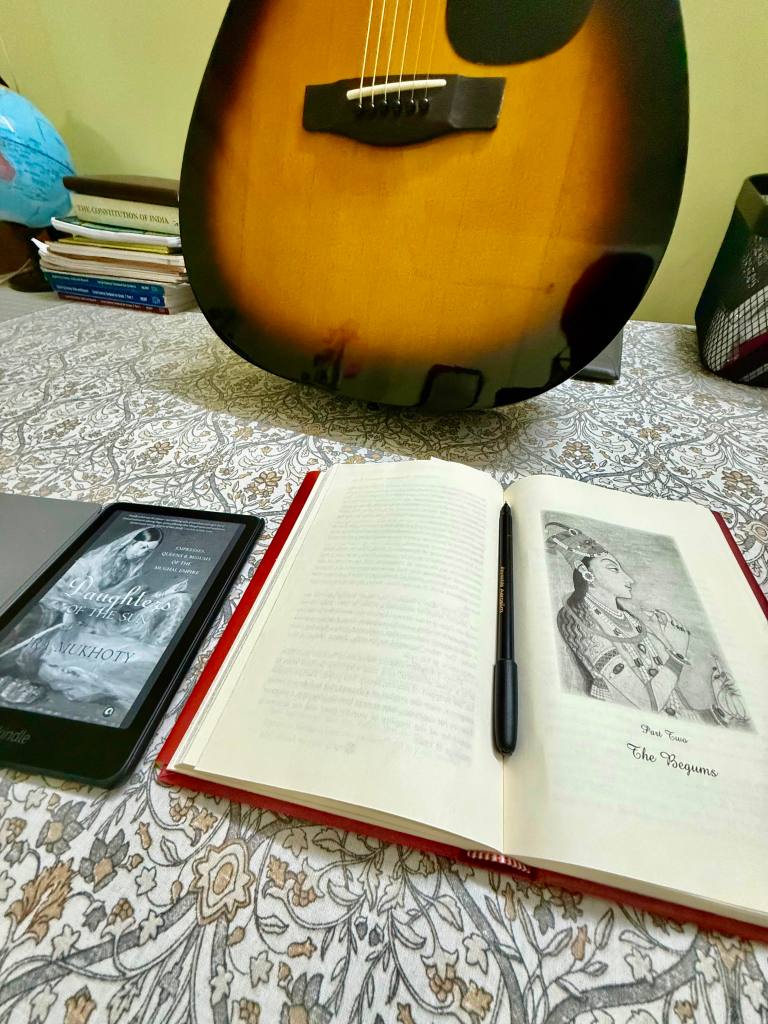
Reading more deeply changed that perception.
What fascinated me was not simply the presence of Mughal women in history, but the many ways in which they exercised influence in an empire that is often remembered almost exclusively through its male rulers. Their stories reveal that power is not always expressed through a throne. Sometimes it is exercised through diplomacy, commerce, patronage, scholarship, architecture, negotiation and the ability to shape the decisions of an empire.
In Daughters of the Sun: Empresses, Queens and Begums of the Mughal Empire historian Ira Mukhoty presents Mughal royal women not as peripheral figures but as central participants in the making of the empire. Through the lives of Hamida Banu Begum, Gulbadan Begum, Mariam-uz-Zamani, Nur Jahan, Mumtaz Mahal and Jahanara Begum, she illustrates that the imperial zenana was far more than a secluded domestic space. It was also a site of political influence, cultural patronage and dynastic strategy.
A complementary perspective emerges from *Tanushree Podder’s Shahenshahs, Begums and Shahzadis,where the intertwined lives of emperors, begums and shahzadis reveal the human dynamics behind imperial politics. Podder shows that the Mughal court cannot be fully understood without recognising the influence of the women who shaped relationships, succession and courtly culture.
Perhaps the most compelling reassessment comes from historian Ruby Lal in Empress: The Astonishing Reign of Nur Jahan. Lal argues that Nur Jahan deserves to be remembered not merely as Jahangir’s consort but as one of the most influential political figures of the Mughal Empire. Through her analysis of Nur Jahan’s role in governance, diplomacy, imperial symbolism, and patronage, Lal challenges conventional narratives that have long minimised women’s political authority.
Reading these works together reveals a common thread. None of them romanticises Mughal women or portrays them as exceptions to history. Instead, they demonstrate that women negotiated influence in diverse ways. Through statecraft, diplomacy, commerce, architecture, literature, philanthropy, and succession politics. Their authority was often informal, yet undeniably consequential.
What stayed with me most was not simply learning about remarkable women, but recognising how historical narratives evolve. Every generation of historians revisits the past with new questions, recovering voices that earlier accounts overlooked or diminished. These books remind us that history is richer when it includes those who have long remained at its margins.
As a reader, I began this journey expecting biographies of queens and princesses. I finished it with a deeper appreciation of the Mughal Empire itself. To understand an empire, it is not enough to study the rulers who occupied the throne; one must also understand the women whose intellect, resilience, patronage and political acumen helped shape its course.
Perhaps that is the greatest lesson these books offer,history is never complete until we learn to read beyond the throne.

Leave a comment